Sources of Reverse Leakage Current (IR) include:
- Minority carrier drift current in the depletion region - increases significantly with temperature.
- Leakage current at the PN junction surface (affected by passivation layer quality).
- Localized electric field concentration current caused by non-uniform doping.
- The IR of an ESD diode is typically designed to be < 1 µA (at 25℃) to avoid affecting the quiescent operating point of the protected circuit.
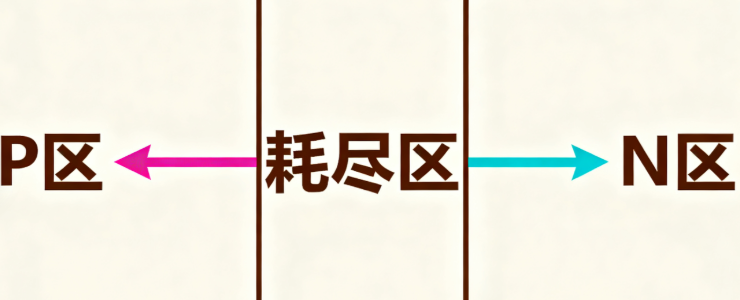
- How to understand minority carrier drift current in the depletion region?
- Source of Minority Carriers: Minority carriers are the minority charge carriers on each side of the PN junction (electrons in the P-region, holes in the N-region). They are generated by thermal excitation, their quantity is much lower than majority carriers, but they always exist.
- Driving Force for Drift: The depletion region has a built-in electric field (direction from N-region to P-region), which exerts a directional force on minority carriers. Negatively charged electrons are pushed toward the N-region, and positively charged holes are pushed toward the P-region.
- Formation of Current: The directional movement of minority carriers across the depletion region driven by the electric field force constitutes drift motion. The superposition of this motion from a large number of minority carriers forms the minority carrier drift current.
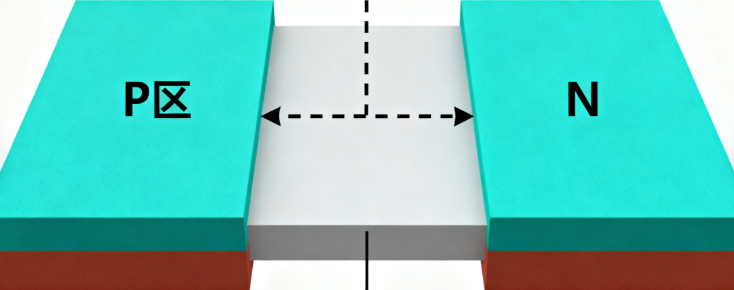
- Leakage current at the PN junction surface (affected by passivation layer quality)
- Defect Density:: If the passivation layer (e.g., SiO₂, SiNₓ) contains pores, impurities, or lattice defects, they can become carrier "channels." These defects lower the carrier recombination barrier, making it easier for surface minority carriers to traverse, directly increasing leakage current.
- Coverage Integrity: If the passivation layer has pinholes, cracks, or discontinuous coverage, it exposes the PN junction surface to the external environment. Exposed areas can form surface states, leading to irregular carrier transport, and external impurities can easily infiltrate, further aggravating leakage current.
- Interface State Density:: If there are a large number of dangling bonds or defect states at the interface between the passivation layer and the PN junction surface, they can become carrier recombination centers and transport paths. The lower the interface state density, the lower the probability of carrier capture and transport, making it easier to suppress leakage current.
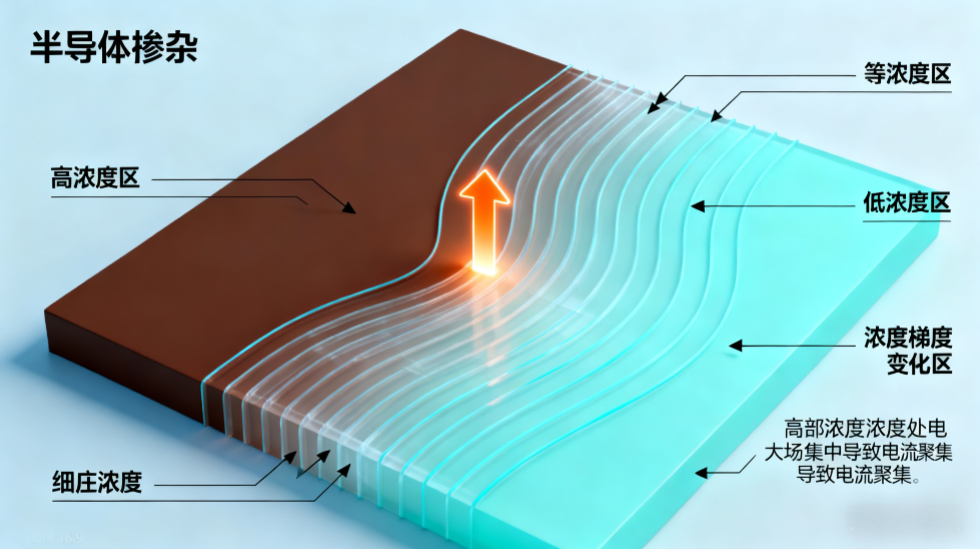
- Non-uniform doping leads to concentration gradients: If local areas have higher impurity concentrations during doping (e.g., uneven diffusion, ion implantation offset), a significant impurity concentration difference forms between these high-concentration areas and surrounding low-concentration areas.
- Concentration gradients induce localized electric fields: The majority carrier concentration in highly doped regions is much higher than in low-doped regions. The diffusion tendency of carriers disrupts local electrical neutrality, thereby forming an additional electric field pointing from the high-concentration region to the low-concentration region.
- Electric field guides current concentration: The localized electric field exerts a directional driving force on carriers. Simultaneously, high-doping regions have lower resistance, making it easier for carriers to gather and flow directionally there, ultimately causing current to concentrate in the localized high-doping region.
In summary, the IR leakage current of an ESD diode is the result of a combination of product characteristics and silicon process technology factors!
ESD Parameter Table: https://www.yint.com.cn/products/emsproduct/esd/index.html
How does the PN junction structure of an ESD protection diode affect its discharge capability? https://www.yint.com.cn/news/knowledge/760.html
What is the difference in the physical mechanism between Avalanche Breakdown and Zener Breakdown in ESD protection diodes?https://www.yint.com.cn/news/knowledge/758.html
What is the fundamental difference between ESD Electrostatic Protection Diodes and ordinary Rectifier Diodes? https://www.yint.com.cn/news/knowledge/757.html



 Global









 Hot News


 沪公网安备31011702889749号

