


 Global









Atsuyoshi Koike, CEO of Rapidus, stated in an exclusive interview with EE Times in Brussels that Rapidus will receive push from Japan's CHIPS Act and IBM to launch the only semiconductor foundry in Japan that manufactures the world's most advanced silicon, only two years behind industry giant TSMC. Xiaochi and his team of over 100 people are taking on a once-in-a-lifetime challenge.
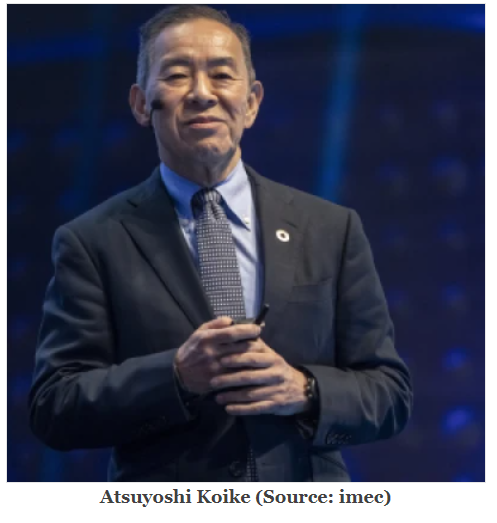
Xiaochi is a seasoned figure in the chip industry, who recently worked at Western Digital and founded Trecenti, a Japanese contract manufacturer, 20 years ago. Xiaochi said that the reason why this company failed was because it had too close ties with chip manufacturer Hitachi. Xiaochi's goal is to completely change the standard practice of processing hundreds of wafers at once. Rapidus plans to quickly eliminate production issues and shorten cycle times by extracting data from a single wafer instead of hundreds of wafers. The company will also use wafer bonding technology to accelerate production, which has just begun to gain industry adoption. Xiao Chi said, "We can stick one wafer onto another in different ways to shorten the cycle time. This is a new idea Rapidus will rely on the assistance of Japan's CHIPS Act and form an alliance with IBM to begin producing 2nm chips before 2027. This is after TSMC launched its 2nm process in 2025. Nohara is responsible for implementing the CHIPS Act of the country. Japan and the United States have been working hard to reduce their dependence on China in the semiconductor supply chain, and Rapidus is a product of this partnership. Nohara stated at the ITF World event hosted by the Inter University Microelectronics Center (IMEC) in Brussels in May that "establishing global partnerships in research and mass production of next-generation semiconductors is the most important part of our strategy." The collaboration between Rapidus, IMEC, and IBM is its first project. ” Imec will help Rapidus develop building modules for mass production of 2nm chips that can be used in 5G communications, quantum computing, data centers, autonomous vehicle and digital smart cities. Starting with $37 billion, Rapidus will need to invest approximately $37 billion to begin production, "Koike said. He and Nohara from the Ministry of Economy, Trade and Industry did not disclose how much subsidy the Japanese government will provide. According to an article in Foreign Policy, TSMC's newly built $8.6 billion chip factory in Japan will receive subsidies from the Ministry of Economy, Trade and Industry, accounting for 40% of the cost. According to Reuters, Rapidus will receive subsidies worth approximately $2.5 billion from METI. Yuriko Koike said that the Japanese government's financial support may not be as generous as other places such as the United States and Europe that are implementing their own CHIPS laws. The government has provided significant support for the semiconductor industry, "said Xiaochi. I think the situation is not very good in Japan, "said Koike. Large Japanese companies such as Sony, NTT Communications, and a joint venture between Toyota and Denso will invest in Rapidus. He did not disclose the scale of this investment. Rapidus plans to assemble and test at its factory, including heterogeneous integration. This can also simplify the cycle time. Japan has many excellent equipment and material companies, "said Koichi. They are willing to join us, "IBM confirmed its partnership with Rapidus. We believe that our collaboration with Rapidus will be successful and effectively implemented, "IBM spokesperson Bethany McCarthy told EE Times. We have recently welcomed the first batch of Rapidus researchers who will join us on-site at Albany Nanotechnology Company. ”According to Xiaochi, IBM will help Rapidus achieve its goal of 2 nanometers. This is a key issue because Japan's logic technology is 10 to 15 years behind, "he said. He also said that Rapidus does not intend to directly compete with TSMC in the foundry business. "We hope to target the specific manufacturing market of this technology," he said, pointing out that the key areas include high-performance computing and edge computing combined with artificial intelligence. When it comes to car chips, Xiaochi's eyes light up. The automotive industry is an opportunity, "he said. "Edge computing is a potentially good opportunity." Analysts weigh the chances of success Paul Triolo, global technology client consultant for Albright Stonebridge Group, stated in an exclusive interview with EE Times that given the cautious strategy of the Japanese government, Rapidus has a high chance of success. Japan has adopted a more strategic and balanced approach, "he said. They didn't try to surpass TSMC. They said, 'We hope these companies become participants in the next generation of technology.' The main challenge facing Rapidus will be commercializing the 2nm technology announced by IBM in May 2021, which is the first 2nm technology launched globally by the company's semiconductor research facility in Albany, New York. News from eetimes.com
 Hot News


 沪公网安备31011702889749号

