


 Global









Recently, the world's first 32-bit RISC-V architecture microprocessor based on two-dimensional semiconductor materials, Wuji, developed by the team of Zhou Peng and Bao Wenzhong from Fudan University, appeared on the cover of Nature magazine; The processor integrates 5900 transistors and has completed independent research and development of the entire chain from materials to architecture to chip fabrication through a unique integrated process of independent innovation.
Realizing the technology of enclosed gate multi bridge channel transistors: For 3-5 nanometer node transistor technology, the Zhou Peng team validated enclosed gate multi bridge channel transistors with double-layer channel thicknesses of 0.6/1.2 nanometers, achieving the integration and unity of high driving current and low leakage current, providing a new approach for the development of high-performance and low-power electronic devices.
Performance comparison:
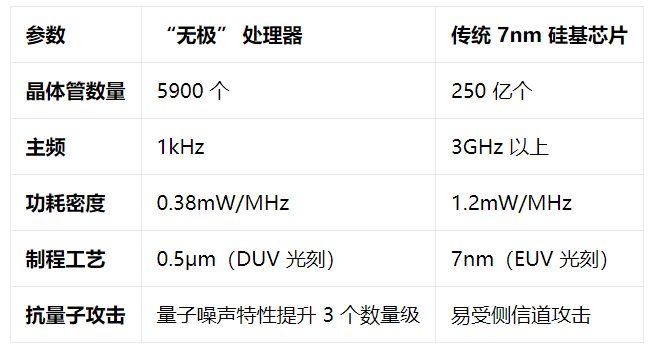
According to media reports, industry experts have evaluated "Wuji" as follows:
Review expert from Nature: 'Wuji' is not only a technological breakthrough, but also the prelude to a materials revolution
TSMC R&D Director: China's full chain independent technology in the field of two-dimensional semiconductors will accelerate the global post Moore era process
China Semiconductor Industry Association: 'Wuji' provides a new path for domestic chips to break through, and is expected to stimulate disruptive applications in fields such as AI and aerospace
Performance advantages meet market demand:
Excellent performance in low-power scenarios: This processor achieves nanometer level power consumption with micrometer level technology, reducing power consumption by 95% compared to similar silicon-based products. It has significant advantages in scenarios with strict power requirements such as IoT terminals and wearable devices. For example, it can be applied to smart watches, implantable medical devices, etc., and can work stably with extremely low power consumption for a long time, extending the battery life of the device.
Adapting to emerging product demands: The mechanical flexibility of two-dimensional materials provides chip level solutions for emerging products such as foldable screen phones and smart fabrics. Its GB level data storage capability can support localized data processing for devices such as AR glasses, meeting the demand for lightweight, high-performance chips in emerging consumer electronics products.
Meeting the requirements of automotive grade chips: Through AI enabled process optimization technology, a yield of 99.77% has been achieved, meeting the reliability requirements of automotive grade chips. In the field of new energy vehicles, it can be applied to intelligent cockpit environment perception systems, with a computing speed of 4.2 billion times per second, which can efficiently process multi-sensor fusion data.
Industrialization advantages help promote:
Reduce production costs: 70% of manufacturing processes are compatible with existing silicon-based production lines, which significantly reduces the cost of mass production transformation and makes it easier to achieve large-scale production of this technology on the existing industrial basis, accelerating the transformation speed of products from laboratory to market.
Forming technical barriers: The team has established more than 20 core patent systems, which have formed certain technological barriers, helping to protect their own intellectual property rights, occupying a favorable position in the global semiconductor industry competition, and providing strong guarantees for attracting investment and cooperation.
Relying on a mature ecosystem: Based on the open-source RISC V architecture, the domestic independent RISC V ecosystem is becoming increasingly mature, and the market size is expected to exceed 40 billion yuan by 2028, providing a favorable ecological environment for the application and development of "infinite" microprocessors, facilitating integration and innovation with other related technologies and products.
The market substitution space is huge: With the continuous development and optimization of technology, it is expected that the global market share will reach 15% by 2030, mainly replacing chips for specific application scenarios with processes below 28nm. Especially in the field of edge computing and artificial intelligence, its extremely low power consumption characteristics and 1 billion level instruction programming capability can make it an ideal choice for mobile intelligent terminals such as UAVs and service robots. It can achieve all-weather edge computing in fields such as intelligent security, agricultural inspection, and is expected to replace 30% of the market share of traditional silicon based MCU chips in five years.
The future is bright, but there are also significant challenges, such as the slow growth rate of two-dimensional material wafers, which are currently only 1/5 of silicon-based wafers, and the need to further improve chip integration and perfect industrial chain support. But overall, the birth of the "Wuji" microprocessor marks China's first mover advantage in the "post Moore era", which is expected to promote the restructuring of the global semiconductor industry pattern and contribute to a better life for humanity.
 Hot News


 沪公网安备31011702889749号