


 Global









USB interfaces are widely used in modern electronic devices for data transmission and power delivery. However, USB ports are highly vulnerable to electrostatic discharge (ESD), surge events, and transient voltage spikes.
Without proper protection, these disturbances can damage sensitive ICs, disrupt data transmission, or reduce system reliability.
This page introduces USB TVS diode protection solutions, including device selection guidelines and recommended components for different USB standards.
USB ports are directly exposed to external environments and are one of the most common entry points for ESD events.
Typical risks include:
- Electrostatic discharge (ESD) from human contact
- Cable plug-in and unplugging transients
- Surge disturbances from connected devices
- Signal integrity degradation in high-speed data lines
Without protection, these risks can lead to data errors, communication failure, or permanent damage to USB controllers.
| Interface | Recommended Devices | Package | Key Features |
| USB 2.0 | ESDSRV05-4, ESDSR05 | SMD | Low capacitance, fast response, suitable for full-speed/high-speed USB |
| USB 3.0 | ESD1065P, ESDSR05, ESD0524P | DFN / SMD | Ultra-low capacitance, high-speed signal integrity |
| HDMI | ESD0524P, ESDUCL5V0D8B, ESDUCL5V0D9B | SMD | Multi-line protection, low capacitance for high-speed data |
| VGA | ESDSRVLC05-4, ESD0524P, ESDUCL5V0D8B, ESDUCL5V0D9B | SMD | Robust ESD protection for legacy video interfaces |
When selecting a USB TVS diode, the following parameters are critical:
- Working voltage (VRWM): must match USB voltage levels (typically 5V)
- Clamping voltage (VC): should be as low as possible to protect ICs
- Capacitance: extremely important for high-speed USB signals
- Response time: should be in picoseconds or nanoseconds
- Leakage current: low leakage ensures stable operation
- Package size: must fit compact PCB layouts
For USB 3.0 and higher-speed interfaces, ultra-low capacitance devices are required to maintain signal integrity.
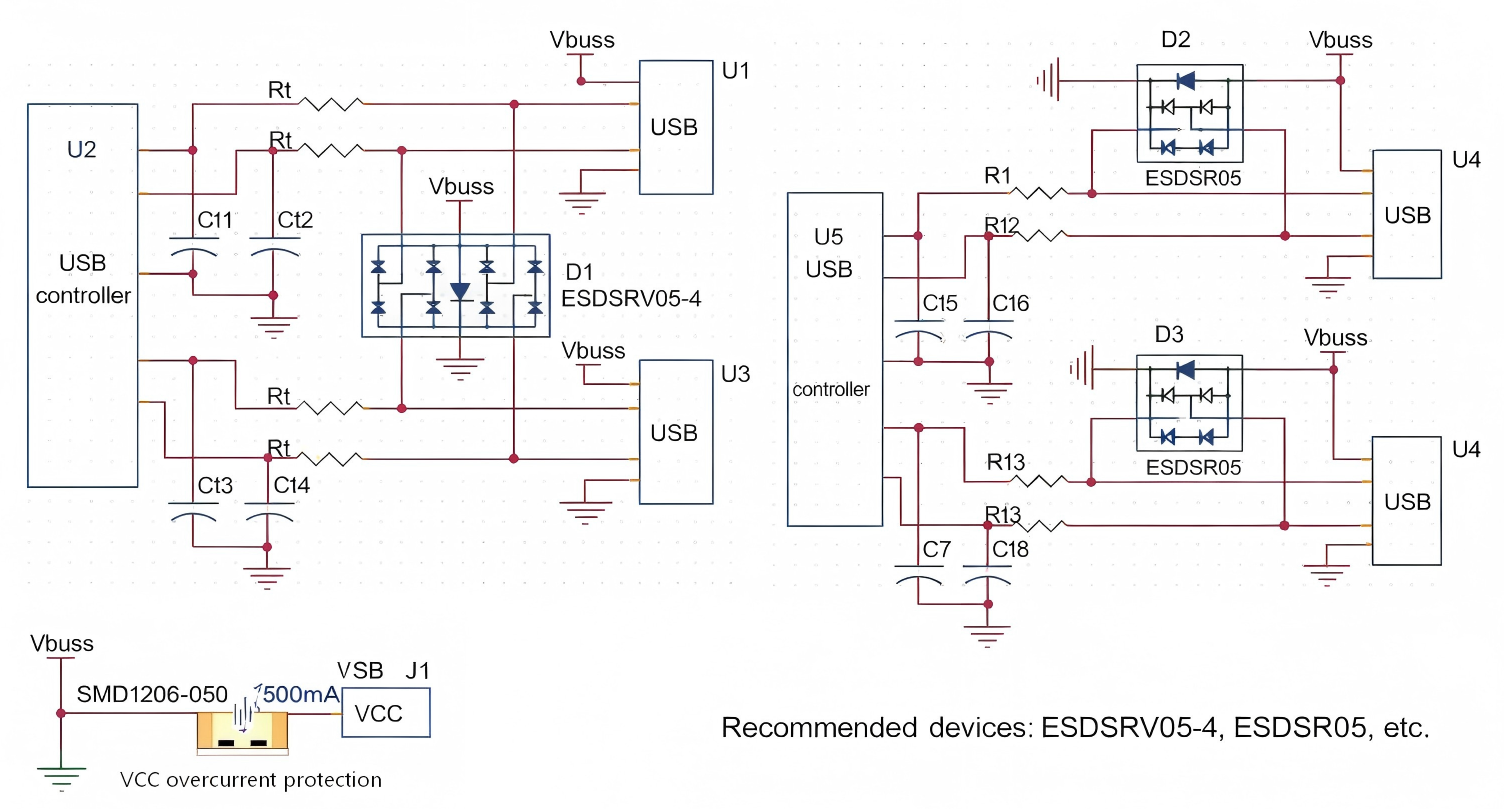
This diagram shows a typical USB 2.0 ESD protection circuit using multi-line TVS diodes.
Low capacitance ESD protection devices such as ESDSRV05-4 or ESDSR05 are placed close to the USB connector to protect D+ and D− data lines from electrostatic discharge.
For VBUS lines, additional protection components such as TVS diodes or resettable fuses can be used to improve system reliability.
Proper placement near the connector and solid grounding are critical for effective protection performance.
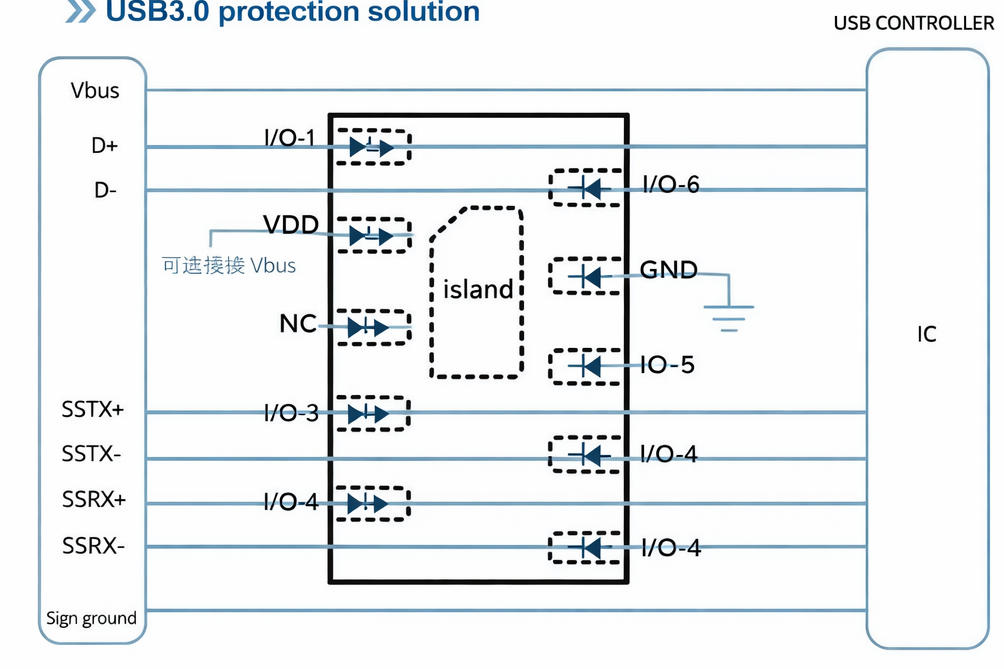
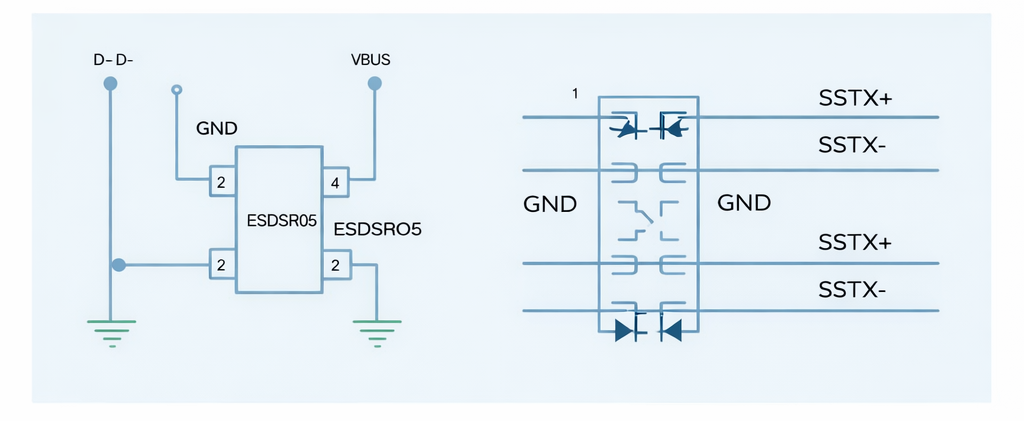
This diagram illustrates a typical USB 3.0 ESD protection solution for high-speed interfaces.
USB 3.0 includes both traditional USB 2.0 lines (D+ / D−) and high-speed differential pairs (SSTX / SSRX), requiring ultra-low capacitance protection devices to maintain signal integrity.
Devices such as ESD1065P or a combination of ESDSR05 and ESD0524P can be used to provide effective protection.
For high-speed signal lines, low capacitance and fast response are critical to avoid signal distortion. Protection devices should be placed as close as possible to the connector with proper grounding design.
YINT is a professional manufacturer of circuit protection components with extensive experience in TVS diodes, ESD protection devices, varistors, and thermistors.
We provide stable quality, fast technical support, and flexible replacement solutions for global customers. Our engineering team can assist in selecting suitable alternatives based on part number, datasheet, or application requirements.
|
Need Help Selecting USB TVS Protection? If you are designing USB interfaces, please contact us. global@yint.com.cn - USB version (2.0 / 3.0 / Type-C) - Data rate requirements - Voltage level - Application scenario Our engineering team will recommend the most suitable protection solution quickly. |
Q1. Why is low capacitance important for USB TVS diodes?
A. High capacitance can distort high-speed signals and affect data transmission.
Q2. What TVS diode is suitable for USB 3.0?
A. Ultra-low capacitance ESD protection devices are recommended.
Q3. Where should the TVS diode be placed?
A. As close as possible to the USB connector.
Q4. Can YINT provide design support?
A. Yes, we provide application-based recommendations and technical support.
 Hot News


 沪公网安备31011702889749号

