Home
CN
Products
EMS Products
TVS Diodes
ESD Protection Diodes
Resettable Fuses
Thyristor Surge Suppressor
Gas Discharge Tubes
Schottky Barrier Diodes
Varistors
NTC thermistors MF72
eFuse
NTC thermistors MF52、MF58
EMI Products
Common Mode Choke
Power Inductors
Ferrite Beads
Common-mode Chokes for CAN FD
Sensors
Temperature sensor devices
Temperature sensor module
Power Devices
MOSFET
Rectifier Diodes
Zener Diodes
Surge Protective Device
SPD for Power Supply
SPD for Signal
SPD for Power + Signal
SCB
Applications
Industrial
Medical & healthcare
Automotive
Energy infrastructure
Consumer electronics
Electronic detonator
Client Cases
Development
Industry Layout
Patent Qualifications
Production Management
Product Planning
Our Future
News & Events
Corporate News
Industry News
Product Knowledge
Training & Education
About
Company Profile
Cultural Philosophy
Organizational Structure
Development History
Sales Network
Honors and Certifications
Contact Us
Support
Sample Request
Technical Support
EMC/CNAS Test
FAQ
Cross-reference search
Careers
Career Development
Employee Culture
Benefits and Compensation
Search jobs
Global
CN
Home
Products
EMS Products
EMI Products
Sensors
Power Devices
Surge Protective Device
Cross-reference search
TVS Diodes
ESD Protection Diodes
Resettable Fuses
Thyristor Surge Suppressor
Gas Discharge Tubes
Schottky Barrier Diodes
Varistors
NTC thermistors MF72
eFuse
NTC thermistors MF52、MF58
Common Mode Choke
Power Inductors
Ferrite Beads
Common-mode Chokes for CAN FD
Temperature sensor devices
Temperature sensor module
MOSFET
Rectifier Diodes
Zener Diodes
SPD for Power Supply
SPD for Signal
SPD for Power + Signal
SCB
Applications
Industrial
Medical & healthcare
Automotive
Energy infrastructure
Consumer electronics
Electronic detonator
Industrial Connectivity and Communication
Industrial automation
Industrial motion and drive
Sensing and Human machine interface (HMI)
Lighting
PLC IoT gateway
Power line Carrier
HMI
PLC
Industrial controller I/O system
Inverter for motion control system
Servo drive for motion controller
Industrial alarm devices
Sensors
Smart lights
Landscape lights
Diabetes healthcare
Hospital patient care
In-vitro diagnostics
Blood glucose monitor
Dental medical equipment
Oxygen concentrator
Blood pressure monitor
Pulsating pulse oximeter
Comprehensive diagnostic and treatment equipment for tinnitus and hearing loss
Infusion pump
Electronic chair
Electronic bed
CPAP ventilator
Electrocardiogram (ECG)
Portable blood coagulation analyzer
Semi-automatic thromboelastography
Immunoassay analyzer
Fecal analyzer
Flow cytometer
Molecular analyzer
Advanced driver assistance systems (ADAS)
Body electronics
Car access & security systems
Car access & security systems
Lighting
Infotainment & cluster
Car entertainment system
Power supply
In-cabin camera module
Mirror replacement/camera mirror system
Front camera
Rear door module
Wiper module
Kick to open module
PEPS
Heat pump module
Interior light
Headlight Adaptive LED Driver Module
Headlight HB/LB LED Driver Module
Small light
Rear light
Zone control module
Domain gateway
Automotive USB charging
Premium audio
Automotive display
Onboard battery charger
12V/48V power distribution box
48V New Energy System
Energy storage systems
Charging pile
Smart meter
Smart circuit breakers
Grid automation
Micro inverter
Uninterruptible power supply
Battery management system (BMS)
DC charging (pile) station
AC charging (pile) station
Gas meter
Electricity meter
Water meter
Smart electrical panel
Solid state circuit breaker (SSCB)
Industrial circuit breaker
GFCI/RCD circuit breaker
DFCI circuit breaker
AFCI circuit breaker
Fault indicator (FI)
Power quality meter
Power quality analyzer
Grid asset monitoring
High-voltage direct current (HVDC) power transmission
Personal computing and entertainment
Smart Home and IoT
Personal travel and drones
Power and charging
VR glasses
Desktop computer
Smart parcel lockers
Smart lock
Two-wheeled vehicle tracker
E-BIKE
Drone
PD
Electronic detonator
Electronic detonator
Support
Support
With over a thousand cooperative customers and 17 years of service experience, we can provide you with everything from model selection to technical support
Sample Request
Technical Support
EMC/CNAS Test
FAQ
Cross-reference search
Development
Development
Our unyielding mission is to continuously innovate and lead the industry's progress.
Industry Layout
Patent Qualifications
Production Management
Product Planning
Our Future
News & Events
News & Events
We will share every little bit of our life with you at all times
Corporate News
Industry News
Product Knowledge
Training & Education
About
About
Yinte Electronics integrates technology research and development, chip manufacturing, packaging and testing, sales, and service
Company Profile
Cultural Philosophy
Organizational Structure
Development History
Sales Network
Honors and Certifications
Client Cases
Contact Us
Careers
Careers
Unleash potential together, shape a healthy future for humanity
Career Development
Employee Culture
Benefits and Compensation
Search jobs
Select model to search
|
Cross-reference search
Online Message
Name
*
Company
Email
*
Phone
Message
Contact
News & Events
We will share every little bit of our life with you at all times
Corporate News
Industry News
Product Knowledge
Training & Education
News & Events
We will share every little bit of our life with you at all times
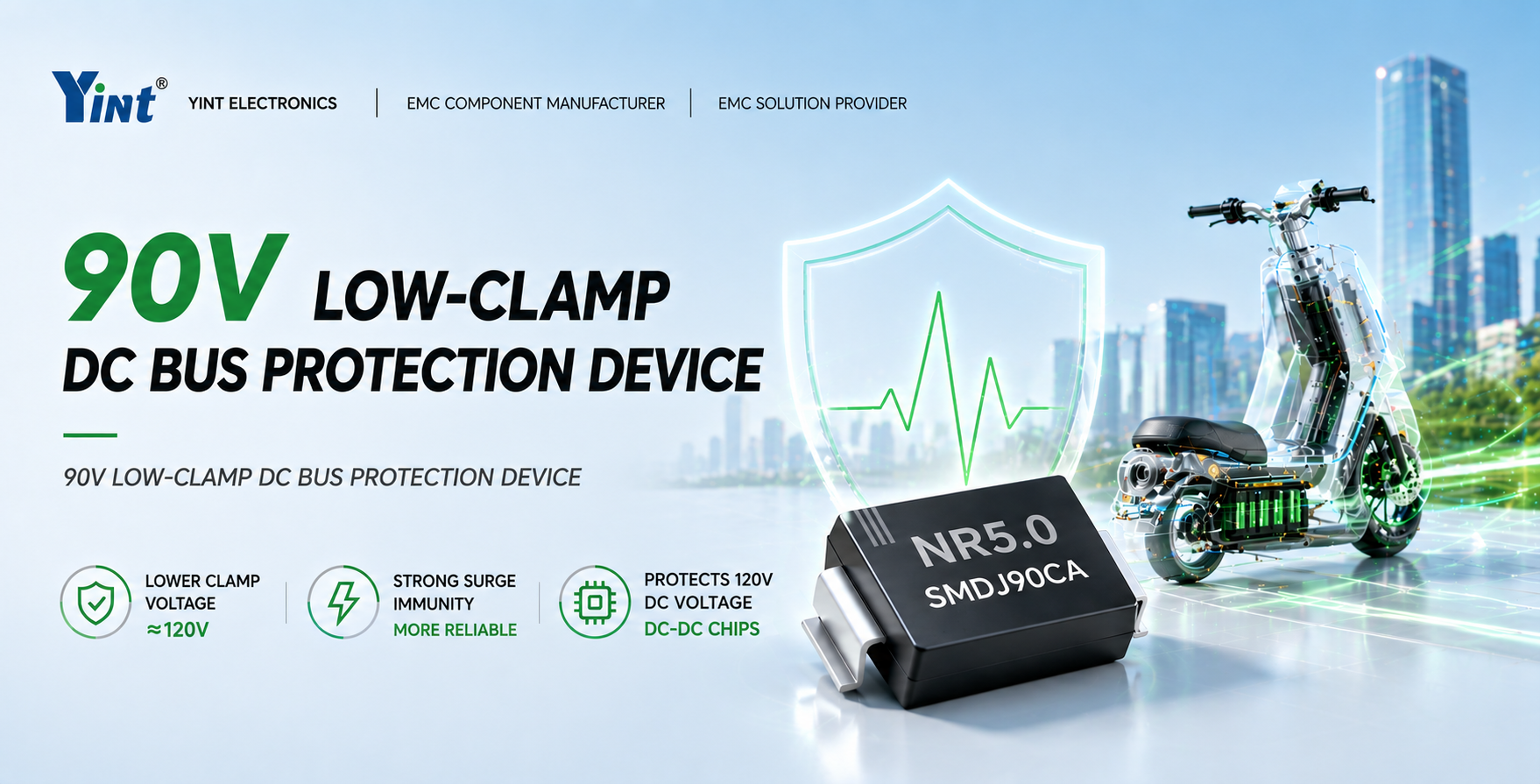
90V DC Bus Low-Clamping TVS Surge Protection Solution|120V Withstand DC
2026-05-14
NR5.0SMDJ90CA low clamping TVS diode protects 90V bus systems, clamping surges near 120V to prevent DC-DC chip breakdown and latent failure.
Explore More
Inductor Selection: Basic Principles
2025-03-24
01 Basic Knowledge and Importance of Inductors
Inductors are components that can convert electrical energy into magnetic energy and store it. Their structure is similar to transformers but with only one winding. They have certain inductance, characterized by passing direct current and impeding alternating current. When current flows through a conductor, an electromagnetic field is generated. Inductance is a physical quantity that measures the ability of a coil to generate electromagnetic induction; when current is applied to a coil, a magnetic field is generated around the coil, with magnetic flux passing through. The larger the applied current, the stronger the magnetic field and the greater the magnetic flux. The ratio of magnetic flux through the coil to the applied current is proportional, and their ratio is called the self-inductance coefficient, which is inductance.
The role of inductors...
The PoC inductor 3225 size series has officially entered mass production, empowering in-vehicle intelligent high-speed interconnection
2025-03-15
The company's inductor POC 3225 series has been developed and is ready for mass production. This product, officially launched in February 2025, is specifically designed for advanced driver assistance systems (ADAS) and in-vehicle camera networks. With a compact size of 3.2mm×2.5mm, it achieves industry-leading wideband performance and high reliability, facilitating lightweight automotive wiring harnesses and high-speed data transmission The POC 3225 series adopts an innovative dual-winding structure design, achieving a high performance at 1MH
How to Choose Between 51μH vs 100μH Common Mode Inductors for CAN Bus?
2025-03-14
1. Why Do We Need Common Mode Inductors?
1.1 CAN bus interference mainly comes from common mode noise and differential mode noise. Common mode noise commonly includes ground loop interference and EMI (electromagnetic interference), which is generated simultaneously in both transmission lines, with potential referenced to ground.
For example: In complex electromagnetic environments, electromagnetic interference generated by nearby large electrical equipment during operation may enter the CAN bus through space coupling, forming common mode noise ; Differential mode noise is mainly signal crosstalk, generated between two transmission lines. For instance, during high-speed data transmission, signals from adjacent signal lines may interfere with each other, causing...
EMC of CAN and CAN FD in New Energy Vehicles
2025-02-22
1 Background of New Energy Vehicle Communication Networks
With the rapid development of new energy vehicles, the intelligence and automation level of vehicles continues to improve, making communication between electronic control units (ECUs) within vehicles increasingly critical. The communication network is like the "nervous system" of new energy vehicles, responsible for transmitting various control instructions and data information, ensuring coordinated operation of various vehicle systems.
In new energy vehicles, the battery management system (BMS) needs to communicate in real time with the motor controller (MCU), vehicle controller (VCU), etc., to achieve precise...
TVS Transient Suppression Diode: The "Safety Guard" of Electronic Circuits
2025-02-22
1. What is a TVS Tube?
TVS, or Transient Voltage Suppressor Diode, is a new type of highly efficient circuit protection device that plays a key role in preventing surge and overvoltage protection in electronic circuits. When the two ends of a TVS tube experience instantaneous high-energy impact, it can change the impedance between its terminals from high to low at extremely high speed (sub-nanosecond level), absorb a large instantaneous current, clamp the voltage across its terminals to a predetermined value, thereby protecting subsequent circuit components from transient...
In Boost Circuits, Selecting Inductors Requires Considering the Following Key Aspects?
2025-01-22
In Boost circuits, selecting inductors requires considering the following key electrical parameters
Inductance value: According to the formula
Calculate, where is input voltage, is output voltage, is diode forward voltage drop, is output current, and is switching frequency. Generally, larger inductance values result in better output voltage stability, but increase volume and cost2.
Current parameters:
Rated current: The inductor's rated current should be greater than the maximum continuous operating current in the circuit. It is generally recommended to select an inductor with a rated current 20%-30% larger than the circuit maximum current1.
Saturation...
How to Choose Inductors in Buck Circuits?
2025-01-22
In Buck circuits, selecting inductors requires considering the following multiple aspects:
Inductance value: According to the working principle and formula of Buck circuits
to calculate the required inductance value. Where is input voltage, is output voltage, is switching frequency, and is allowable inductor current ripple. Generally, larger inductance values can make output voltage ripple smaller, but will increase inductor size and cost, and may also reduce dynamic response speed; if inductance value is too small, it cannot effectively filter ripple, leading to unstable output voltage...
What is Skin Effect in Inductors? How to Reduce It?
2025-01-22
Skin effect in inductors refers to the phenomenon where when alternating current passes through an inductor element, the current concentrates on the surface of the inductor conductor, while the current density inside the conductor is smaller.
Principle of inductor skin effect
Electromagnetic induction effect: When alternating current passes through an inductor coil, it generates an alternating magnetic field inside and around the coil. According to Faraday's law of electromagnetic induction, this alternating magnetic field generates an induced electromotive force inside the inductor conductor, which in turn produces an induced current. Due to the larger rate of change of magnetic flux in the central part of the inductor, the induced electromotive force and induced current are also larger. These induced currents interact with the original current...
New Energy Vehicle Ethernet Protection
2024-12-05
New Energy Vehicle Ethernet Protection
With the rapid advancement of new energy vehicle technology, traditional industrial Ethernet technology is also being widely used in the automotive industry. Automotive Ethernet provides the automotive industry with topology flexibility, high bandwidth, and anti-interference communication, making it an inevitable trend for the development of intelligent connected vehicles. In 2016, the IEEE standardized the automotive Ethernet system 100BASE-T1 and 1000BASE-T1 developed by the Ethernet Alliance Committee to meet specific requirements of automotive applications, especially in terms of electromagnetic interference (EMI) and electromagnetic compatibility (EMC).
总计 444
1
2
...
20
21
22
23
24
25
26
...
49
50



 Global













 沪公网安备31011702889749号
