


 Global









Amidst the hum of AI training servers, computational power is evolving at an unprecedented rate. However, alongside the surge in performance brought by PCIe 5.0, 400G optical modules, and kilowatt-level GPUs come equally "powerful" challenges of Electromagnetic Interference (EMI) and stringent Electromagnetic Susceptibility (EMS). From the high-frequency switching noise on the 48V DC bus to the radiated emissions leakage from high-speed signal cables, and transient threats induced by hot-swapping and Electrostatic Discharge (ESD), any weak point in protection can lead to training interruptions, data packet loss, or even hardware damage. Stable and reliable computational output begins with precise protection for every power entry point and signal channel.

AI server racks are gradually transitioning from traditional AC power supply to 48V DC power supply, and even to the more efficient 54.5V High Voltage DC (HVDC). This "main artery" carries kilowatt-level power. The broadband conducted noise generated by its switching power supply modules (e.g., VRMs) is one of the primary interference sources within the chassis, easily causing Power Port Conducted Emission (CE) non-compliance. Simultaneously, surges induced by lightning strikes or load switching can intrude through the power supply lines, threatening the safety of the entire rack.
For surge protection requirements at levels like DC48V-3KA or DC48V-2KA, YINT Electronics recommends using a Surge Protective Device (SPD) combined with a 14D101K varistor to form a graded protection circuit. The SPD provides primary lightning-level protection, while the 14D101K effectively absorbs medium-energy transient overvoltages, and a TVS diode offers finer clamping protection. These components work synergistically to establish a robust first line of defense for the 48V bus. For the protection of main power entry lines in data centers requiring extremely high surge currents like DC48V-20KA, deploying a professional SPD module is essential.
For suppressing conducted interference (EMI), it is recommended to use a high-current common-mode inductor like the CMZ7060A-701T or larger modules at the power input. Its high impedance characteristic can significantly attenuate common-mode noise, preventing switching noise from radiating outward via the power lines. This is a key component for meeting standards like CISPR 32 for radiated and conducted emissions.
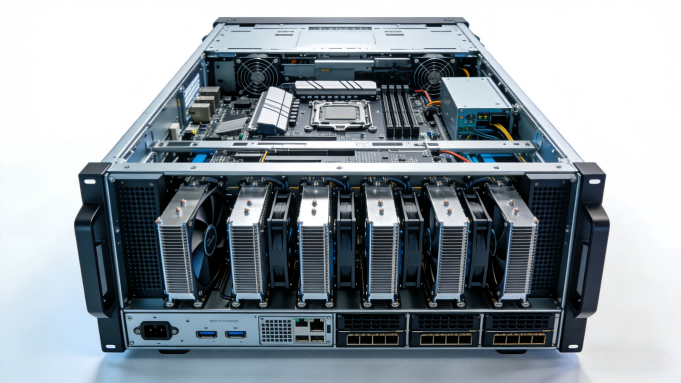
Within the server, the power path undergoes step-down conversions: 48V is converted to 12V to power the mainboard and GPU auxiliary circuits; 12V is further stepped down to 5V/3.3V for interfaces and standby circuits; finally, through multi-phase VRMs, precise voltages as low as 0.7-1.2V with currents up to hundreds of amperes are supplied to core processors (CPU/GPU/NPU) and DDR5 memory. Each conversion stage is a potential noise source, and Power Integrity (PI) directly impacts computational stability.
For the 12V power path, in addition to basic filtering capacitors, for potential surges like DC12V-4KV, a 5.0SMDJ24CA TVS diode can be used for protection. For DC12V-2KV requirements, the SMCJ15CA is a more economical choice. Simultaneously, surface-mount Gas Discharge Tubes (GDTs) like the SMD2920-185-33V can be used for primary protection to discharge high currents.
At lower voltage nodes, such as DC5V and DC3.3V, ESD and surge protection are critical. It is recommended to use an SMBJ6.0CA for surge protection on 5V lines, and employ ultra-low capacitance TVS arrays like the ESD5V0D3B and ESD3V3D3B to provide efficient ESD protection for interfaces like USB and management chips. Their capacitance values are as low as a few picofarads, ensuring no impact on high-speed signal quality.
The bottleneck in AI server performance often lies in data throughput. PCIe 4.0/5.0 x16 lanes, 400G/800G optical modules (QSFP-DD), and 10G/25G management network ports—these high-speed differential signals are extremely sensitive to noise and are themselves sources of high-frequency radiation. Protection solutions must provide robust ESD/surge protection while maintaining extremely low insertion loss and crosstalk between channels.
For ultra-high-speed interfaces like PCIe and NVMe U.2, YINT Electronics recommends using a CMZ20212A-900T common-mode filter to suppress common-mode noise on signal pairs, effectively reducing Radiated Emissions (RE). On the EMS protection side, multi-channel TVS arrays like the ESDULC5V0D9B or ESDLLC5V0D8BH are recommended. These devices feature industry-leading ultra-low clamping voltage and extremely low capacitance below 0.5pF, ensuring minimal impact on signal rates up to 32GT/s for PCIe 5.0, while withstanding ESD strikes of up to ±30kV contact discharge.
For high-speed electrical ports like RJ45-10G Gigabit Ethernet and management interfaces for optical modules like SFP+, the focus of protection is preventing ESD from coupling into the PHY chip via network cables or the chassis. Integrated protection devices like the NRESDTLC5V0D8B are recommended. They combine ESD protection and RF filtering functions, offering a one-stop solution for interference issues. For more common RJ45-1G management ports (e.g., IPMI/iBMC), the solution of a CMZ2012A-900T common-mode filter paired with an ESDLC3V3D3B TVS array has been validated as reliable in numerous server designs.

Even if the main data channels are fortified, debug and peripheral interfaces like VGA, USB, and Type-C can become "side doors" for electromagnetic interference ingress or egress. These interfaces are directly exposed outside the chassis, facing frequent plugging/unplugging and human body ESD threats.
For USB 3.0/3.1 and Type-C interfaces, it is recommended to use a CMZ2012A-900T for common-mode noise suppression and employ multi-channel protection devices like the ESDSRVLC05-4 or ESDLC5V0D8B to provide comprehensive protection for all data lines and the VBUS power line. For VGA display interfaces, although the speed is not high, their long cables are prone to coupling interference. Using protection arrays specifically designed for video ports, like the ESD0524P, is a simple and effective solution.
Building a robust electromagnetic environment for AI training servers is not about simply stacking protective components. It requires implementing a system-level EMC mindset from the initial architectural design phase:
1. Graded Protection
Energy Matching:** Use components with high current-handling capability, like GDTs or varistors, as the first stage at power entry points like 48V. Use TVS diodes as the second stage for finer protection at board-level power entries. Apply the same principle to signal interfaces, placing low-capacitance TVS devices close to connectors.
2. Emphasize Both Filtering and Isolation
Common-mode inductors (e.g., CMZ series) and isolation transformers (e.g., network transformers) are key tools for cutting common-mode interference paths and improving radiated immunity. They should be fully considered for high-speed differential lines and power input lines.
3. Layout and Grounding are Critical
All protective devices must be placed as close as possible to the interference entry point, with short and thick grounding paths. Designing a proper single-point or multi-point grounding strategy for digital ground, analog ground, and chassis ground can fundamentally solve ground loop interference issues.
4. Early Component Selection and Verification
It is recommended to refer to the EMI+EMS matching solutions provided by YINT Electronics for component selection and placement reservation during the schematic design phase. For example, reserve space for 0402 or 0201 packaged ESDULC5V0D9B devices on critical high-speed signal lines, and allocate space for CMZ7060A-701T installation at the 48V input.
On the path to pursuing ultimate computational power, electromagnetic compatibility is the cornerstone ensuring the continuous and stable "thinking" of this precise "brain." By configuring every voltage domain and every data channel of the AI server with the precisely matched, comprehensive EMI suppression and EMS protection solutions offered by YINT Electronics, you will build not only a powerful computing cluster but also a trustworthy digital infrastructure.
 Hot News


 沪公网安备31011702889749号

