


 Global









In automotive electronic systems, streaming media interior rearview mirrors (CMS) are rapidly replacing traditional optical mirrors, becoming a key component for enhancing driving safety and intelligent experience. However, their complex electronic architecture—integrating high-definition cameras, high-speed image processing chips, large-size displays, and various high-speed data interfaces—makes them exceptionally vulnerable in the harsh automotive electromagnetic environment. Engineers often face a thorny dilemma: the CMS performs perfectly in laboratory tests, but once installed in a vehicle for road testing, failures such as black screens, blue screens, screen flickering, and image snow appear one after another. Behind these phenomena is often the combined effect of transient surges in the power supply chain and electromagnetic interference (EMI/EMS) in the signal path. A single protection solution is difficult to cure the root cause.
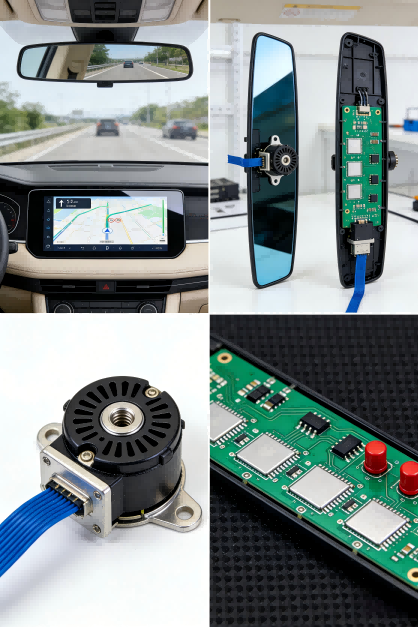
First, Power Supply Chain
The First Line of Defense for CMS System Stability
The power input of the CMS is directly connected to the vehicle battery, meaning it must directly face the most severe transient pulses in the automotive electrical system. According to the ISO 7637-2 standard, vehicles generate high-voltage pulses during operation, such as load dump, cold cranking, and load shedding, whose voltage peaks may far exceed the withstand limit of the internal DC-DC converter in the CMS. For a typical 12V system CMS, its power supply chain is usually: VBAT (9~16V) → Protection Circuit → BUCK (5V) → BUCK/LDO (3.3V/1.8V, etc.). If the front-end protection is insufficient, transient surges as high as tens or even hundreds of volts will directly impact the first-stage BUCK chip, causing permanent damage (manifested as a complete black screen) or triggering the chip's protection mechanism frequently, manifested as intermittent screen flickering or rebooting.
To address this core pain point, traditional single TVS diode solutions often struggle to balance energy withstand and clamping voltage. The automotive 12V/24V power line provides an EMI+EMS integrated protection kit that has been verified for automotive use. For mainstream 12V system CMS, it is recommended to use a combination of the CMZ1211-501T ferrite bead and the SM8K24CA or 5.0SMDJ24C diode at the power supply inlet. The CMZ1211-501T can effectively filter high-frequency noise conducted along the power line, preventing it from interfering with sensitive circuits downstream. TVS diodes like the SM8K24CA, with a power rating above 600W, can clamp high-voltage surges such as ISO 7637-2 Pulse 5a to a safe range with nanosecond-level response speed, ensuring the safety of the downstream DC-DC converter. For high-end CMS supporting wide voltage input (e.g., 9V-36V), TVS diodes with higher clamping voltages, such as SM8K33CA or 5.0SMDJ33CA, need to be selected for adaptation.
Second, High-Speed Video Link
The "Invisible Killer" of Image Quality
Stable power supply is only the foundation. The key to determining whether the image is clear and smooth lies in the integrity of the high-speed video signal link. The core data flow of the CMS includes raw video data captured by the camera (often transmitted via serial interfaces like LVDS, FPD-Link) and possible auxiliary data (such as CAN communication). These high-speed differential signal lines are extremely sensitive to electromagnetic interference. Noise from spatial radiation or cable coupling can disrupt the symmetry of the differential signals, leading to data errors at the receiving end, specifically manifested as snow dots, smearing, color blocks on the screen, or even a direct blue screen due to link loss of lock.
To protect such high-speed differential lines, the parasitic parameters of the protection devices must be sufficiently low to avoid compromising signal integrity. This scenario provides an ultra-low capacitance solution. For example, for LVDS or FPD-Link III interfaces, it is recommended to use the CMZ20212A-900T common mode choke paired with the ESDULC5V0D9B or ESDLLC5V0D8BH TVS array. The CMZ20212A-900T excels at suppressing common-mode noise, while its extremely low differential insertion loss ensures lossless transmission of high-definition video signals. The typical capacitance value of the ESDULC5V0D9B can be as low as below 0.5pF, providing ESD protection up to ±30kV contact discharge while barely increasing signal edge time, perfectly solving screen flickering or reset issues caused by ESD events.
In addition to video streams, the CMS must also communicate reliably with other ECUs in the vehicle body. For instance, it receives vehicle speed and gear signals via the CAN bus to achieve adaptive viewing angles, or controls its folding motor via the LIN bus. These bus networks are distributed throughout the vehicle body and are highly susceptible to becoming paths for conducted interference. Noise on the CAN bus can lead to an increase in communication error frames, causing minor functional abnormalities (such as laggy perspective switching) or, in severe cases, communication interruption between the host and the entire vehicle network.
For CAN/CAN FD bus protection, it is necessary to balance common-mode filtering and differential-mode protection. It is recommended to use CML4532A-510T or CML3225A-101T common mode beads, combined with ESDLC3V3D3B or the specially designed automotive-grade ESD24VAPB TVS diode. The CML series beads can effectively filter high-frequency common-mode noise on the bus, improving communication quality. The ESD24VAPB is specifically designed for 24V systems, providing precise differential-mode surge protection for the CAN_H and CAN_L lines against transient pulses from power supply coupling or inductive load switching.
A robust EMC design for CMS must be systematic and hierarchical. From surge suppression and filtering at the power entry point, to common-mode noise suppression and ultra-low capacitance ESD protection for high-speed video interfaces, and further to noise filtering and transient protection for data buses, each link requires targeted component selection.
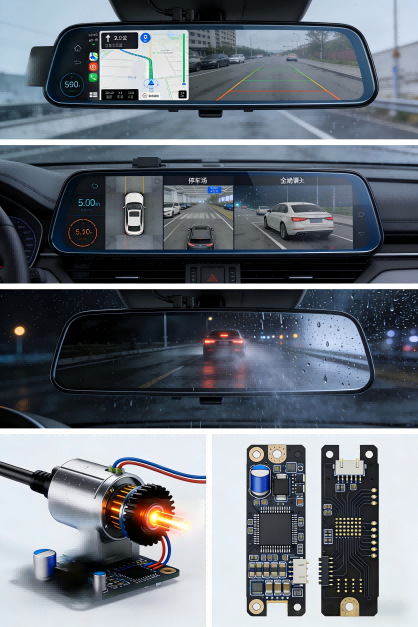
Summary: The recommended comprehensive protection solution for the Camera Monitor System (CMS) is as follows:
1. 12V Main Power Input
Use CMZ1211-501T (EMI filtering) + SM8K24CA (EMS surge protection).
2. LVDS/FPD-Link Video Interface
Use CMZ20212A-900T (EMI common-mode suppression) + ESDLLC5V0D8BH (EMS ESD protection).
3. CAN Bus Communication Interface
Use CML3225A-101T (EMI filtering) + ESDLC3V3D3B (EMS ESD and surge protection).
4. In-Vehicle Camera Side Power Supply
The SMAJ48CA can be selected to provide protection for 48V-powered camera modules.
It is recommended that hardware engineers incorporate the placement and routing requirements of these protection devices into the PCB layout planning from the initial stages. For example, TVS devices should be placed as close as possible to the connector ports to ensure the shortest discharge path; common mode chokes should be positioned where interference is likely to be injected into the signal chain. By adopting this market-proven YINT EMI+EMS combination solution, the reliability of CMS in complex automotive electromagnetic environments can be fundamentally enhanced, minimizing failure rates such as black screens, blue screens, and screen artifacts, thereby meeting the stringent quality and lifespan requirements of automotive-grade products.
 Hot News


 沪公网安备31011702889749号

